Summary
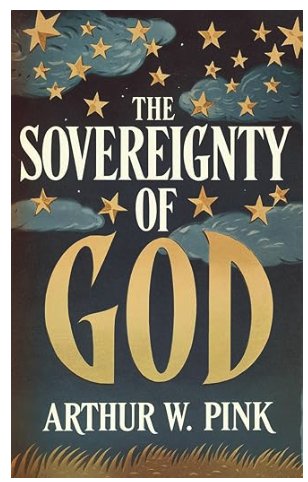
Arthur Walkington Pink wrote The Sovereignty of God in 1918 and revised it throughout his life. It has become one of the most widely read Reformed theological works of the twentieth century. Pink was a British evangelist and biblical scholar who spent decades in relative obscurity, writing a monthly journal called Studies in the Scriptures that reached only a small audience during his lifetime. It was only after his death in 1952 that his work was rediscovered and republished, making him one of the most influential Reformed voices of the modern era. His story itself is a testimony to the providence he spent his life defending.
Pink's central thesis is uncompromising: God is absolutely sovereign over all things. Not generally sovereign. Not mostly sovereign. Absolutely sovereign. Over creation, over nations, over the rise and fall of empires, over every human decision, over salvation and reprobation, and even over evil itself. Pink saw the erosion of this doctrine as the root cause of spiritual weakness in the modern church, and he wrote with the urgency of a man who believed the soul of Christianity was at stake.
The Sovereignty of God in Creation
Pink begins where Scripture begins, with God as Creator. He argues that creation itself is an act of pure sovereignty. God was under no obligation to create anything. He did not create out of need or loneliness. He created out of the overflow of His own glory, and everything that exists, exists because He willed it into being. The universe is not self-sustaining. It depends moment by moment on the sustaining will of God.
Pink draws heavily on passages like Psalm 115:3, "Our God is in the heavens; He does whatever He pleases," and Daniel 4:35, "He does according to His will among the host of heaven and among the inhabitants of the earth. No one can restrain His hand or say to Him, What have You done?" For Pink, these are not poetic exaggerations. They are precise theological statements about the nature of reality. God is not a constitutional monarch who reigns but does not rule. He is an absolute sovereign who governs every atom and every event with meticulous care.
Pink also addresses the relationship between sovereignty and creation's order. The laws of nature are not independent forces operating on their own. They are the habits of God, the regular patterns by which He sustains and governs His world. When a sparrow falls to the ground, it is not a random accident in a mechanical universe. It is a moment governed by the same hand that hung the stars.
The Sovereignty of God in Administration
Having established God's sovereignty in creation, Pink turns to God's governance of history. He argues that nothing happens by chance. There is no such thing as luck, accident, or fate. Every event, from the fall of a sparrow to the rise of an empire, is under the direct governance of God.
This includes events that appear random or meaningless. Pink cites the casting of lots in Proverbs 16:33, "The lot is cast into the lap, but its every decision is from the LORD." He also points to Joseph's story in Genesis, where what humans meant for evil, God meant for good. Pink sees in these passages a God who is meticulously involved in every detail of human history.
Pink traces God's sovereign administration through the history of nations. He shows how God raised up Pharaoh to display His power, how He used Assyria as the rod of His anger against Israel, how He orchestrated the rise of Cyrus to deliver His people from Babylonian exile. History is not a random sequence of events. It is the unfolding of a plan conceived before the foundation of the world by a God who never loses control and never improvises.
Pink also addresses the sovereignty of God over the smallest details of daily life. Your health, your employment, your relationships, your lifespan, the events that appear coincidental, all of these are under the meticulous governance of a God who numbers the hairs on your head and orders the steps of every living creature. Pink insists that there is no category of events that falls outside God's sovereign rule. To admit even one exception is to unravel the entire doctrine.
The Sovereignty of God in Salvation
This is the heart of the book and the section that has generated the most controversy. Pink presents a thorough defense of the Calvinist doctrines of grace: total depravity, unconditional election, limited atonement, irresistible grace, and the perseverance of the saints.
Pink argues that fallen humanity is not merely sick but dead in trespasses and sins. A dead person cannot choose to come alive. Salvation must therefore originate entirely with God. Election is unconditional, meaning God does not choose people because He foresees that they will believe. He chooses them and then grants them the faith to believe. Faith is the result of election, not the cause of it.
He addresses the hardest questions directly. Why does God save some and not others? Pink's answer is blunt: because it pleased Him to do so. God is under no obligation to save anyone. That He saves any is pure grace. That He does not save all is justice. No one receives injustice. The saved receive mercy they did not deserve. The lost receive justice they did deserve. No one has grounds for complaint.
Pink deals extensively with the relationship between God's sovereignty and human responsibility. He insists that both are true. Humans are genuinely responsible for their choices and will be judged accordingly. But underneath human choice is the sovereign decree of God, who works all things according to the counsel of His will. Pink does not attempt to resolve this tension philosophically. He holds both truths simultaneously and insists that our inability to reconcile them reflects the limitations of our understanding, not a contradiction in God's character.
Pink walks through the great examples of sovereign salvation in Scripture. He examines the conversion of Saul of Tarsus, a man who was breathing threats and murder against the church until God struck him down on the Damascus road. He traces the salvation of Lydia in Acts 16, whose heart the Lord opened to respond to Paul's message. He points to Lazarus in the tomb, dead and decomposing, who could do nothing until Jesus called him forth. These are not stories of human decision. They are stories of sovereign grace.
The Sovereignty of God and Evil
Perhaps the most difficult section of the book. Pink tackles the problem of evil head-on. If God is sovereign over all things, is He the author of sin? Pink says no. God permits evil, He overrules evil, and He directs evil toward His purposes, but He is not the efficient cause of evil. The responsibility for sin rests entirely with the creature, not the Creator.
Pink uses the crucifixion as his chief example. The death of Christ was the most evil act in human history, carried out by wicked men who acted freely and culpably. Yet Acts 2:23 says it happened by the predetermined plan and foreknowledge of God. Evil men did what they wanted. And God accomplished what He purposed. Both statements are true simultaneously. The cross is the ultimate proof that God's sovereignty and human moral responsibility coexist without contradiction.
Pink also addresses the hardening of Pharaoh's heart. God says in Exodus that He will harden Pharaoh's heart, and this has troubled readers for millennia. Pink argues that God hardened Pharaoh by withdrawing restraining grace, allowing Pharaoh's own sinful nature to run its course. God did not inject evil into Pharaoh. He simply removed the dam, and Pharaoh's own wickedness flooded out. The moral responsibility remains entirely with Pharaoh.
The Practical Effect
Pink is not interested in sovereignty as mere intellectual exercise. He argues that the doctrine of God's sovereignty is the foundation of all genuine comfort, all real worship, and all authentic peace. If God is not sovereign, then suffering is meaningless, prayer is pointless, and the future is uncertain. But if God truly governs all things, then the believer can rest even in the darkest valley, knowing that nothing has escaped God's control.
Pink also connects sovereignty to evangelism and missions. Far from making evangelism unnecessary, sovereignty guarantees its success. God has His elect scattered among the nations, and the gospel will reach them because the sovereign God has ordained both the end and the means. The missionary goes out not in uncertainty but in confidence, knowing that God will save every soul He has chosen.
Pink closes with a call to humility. The doctrine of sovereignty should not produce arrogance in those who embrace it, but adoration. The proper response to a sovereign God is not theological smugness but worship, reverence, and awe. The one who truly grasps the sovereignty of God falls on his face, not in terror but in wonder that such a God would condescend to save sinners at all.