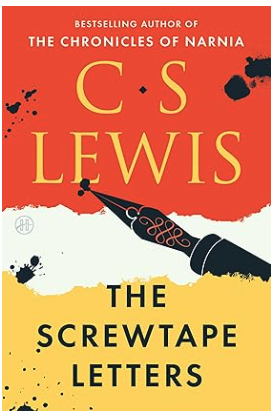
Summary
The Screwtape Letters is one of the most ingenious books ever written about the Christian life. And it accomplishes this by never once speaking from a Christian perspective. Instead, C.S. Lewis invites you into the correspondence of a senior demon named Screwtape, who writes a series of thirty-one letters to his nephew Wormwood, a junior tempter assigned to secure the damnation of a young British man known only as the Patient.
Everything is inverted. God is referred to as the Enemy. Satan is Our Father Below. Heaven is enemy territory. Virtue is a threat. Love is incomprehensible. And the strategies of hell are laid bare with a precision that is both darkly funny and deeply unsettling, because you recognize yourself on almost every page.
Published in 1942 during the darkest days of World War II, The Screwtape Letters became an instant bestseller and remains one of Lewis's most popular works. It is the only book Lewis said he did not enjoy writing. The effort of thinking like a devil, he confessed, left him feeling spiritually suffocated. But the result is a work of extraordinary insight into the mechanics of temptation and the quiet, daily battle for the human soul.
The Art of Distraction
Screwtape's most consistent advice to Wormwood is not about dramatic temptation. It is about distraction. Keep the Patient's mind off anything that matters. Fill his hours with noise, busyness, and trivial concerns. The goal is not to make him a villain. The goal is to make him nothing at all.
This is perhaps the most devastating insight in the book. Hell's strategy is not primarily to produce spectacular sinners. It is to produce distracted, lukewarm, vaguely comfortable people who never quite get around to taking their faith seriously. Screwtape warns Wormwood that the most dangerous thing that can happen is for the Patient to think. Genuine reflection, honest self-examination, real engagement with truth, these are hell's enemies. Far better to keep the man in a fog of routine and sensation, where he neither thinks deeply about God nor deliberately rejects Him. He simply drifts.
Lewis captures this with devastating accuracy. The Patient attends church but critiques the hymns rather than worshiping. He prays but thinks about his own posture rather than addressing God. He reads Scripture but wonders what he will have for lunch. The spiritual life is not destroyed by a single dramatic blow. It is eroded by a thousand tiny distractions that seem harmless in isolation but are lethal in accumulation.
Screwtape also instructs Wormwood to exploit modern media and entertainment. Keep the Patient consuming rather than creating, absorbing rather than reflecting, scrolling rather than praying. The more passive the mind becomes, the less likely it is to encounter the dangerous thoughts that lead to genuine faith. Lewis wrote this in the 1940s, but the application to our age of smartphones and social media is uncanny.
The Conversion Crisis
Early in the letters, the worst happens for Screwtape: the Patient becomes a Christian. Wormwood has failed in his primary assignment. But Screwtape is not panicked. He instructs his nephew to use the conversion itself as a weapon.
First, encourage the Patient to evaluate his new church critically rather than humbly. Let him notice the off-key singing, the annoying woman in the next pew, the vicar's nervous mannerisms. If the Patient begins to see his fellow Christians as objects of mild contempt rather than brothers and sisters, the conversion will produce no real transformation.
Second, keep the Patient confused about what Christianity actually requires. Let him think it is primarily about feelings. When the feelings fade, as they inevitably will, whisper that his faith was not real, that it was just a phase, that nothing has really changed. The goal is to make him evaluate his relationship with God by how he feels on any given morning rather than by the sustained direction of his will.
Screwtape is clear: the most dangerous Christian is not the one who has mystical experiences. It is the one who perseveres in faith when he feels nothing at all. That kind of obedience, dry and unglamorous, is the thing hell fears most. Screwtape calls these dry periods troughs and considers them his most vulnerable moments, because if the Patient continues to obey when all feelings of devotion have evaporated, his faith becomes unassailable.
The Gradual Slope
The most famous passage in the book is Screwtape's description of the safest road to hell. He writes that the safest road to Hell is the gradual one, the gentle slope, soft underfoot, without sudden turnings, without milestones, without signposts.
This is Lewis at his most penetrating. Hell does not need the Patient to commit a spectacular sin. It needs him to make a thousand small compromises that seem insignificant in the moment but collectively carry him miles from where he started. A slightly dishonest conversation here. A minor act of cowardice there. A grudge nursed quietly. A generous impulse suppressed. None of these registers as a crisis. But over months and years, they reshape the soul so gradually that the Patient never notices the distance he has traveled from God.
Screwtape advises Wormwood to think in terms of decades, not days. The slow drift is always preferable to the dramatic fall, because the dramatic fall might produce repentance. The gradual slope produces comfortable numbness, and numbness is exactly what hell wants.
The Weapons of Hell
Beyond distraction and gradualism, Screwtape reveals several specific weapons in hell's arsenal. Pride is perhaps the most versatile. Screwtape delights in the fact that you can even make a man proud of his humility. The moment the Patient begins to think well of himself for his spiritual progress, hell has a foothold. Every virtue can be turned into a vice if the person becomes aware of possessing it.
Then there is the sense of ownership. Screwtape teaches Wormwood to cultivate in the Patient the feeling that his time, his talents, and his body are his own. Once a man truly believes that something belongs to him, rather than being entrusted to him by God, he will defend it, hoard it, and resent anything that threatens it.
Lewis also introduces the concept of the Inner Ring, the desire to belong to an exclusive circle, to be on the inside, to be one of the people who matter. Screwtape recognizes this as one of the most powerful forces in human nature. It can make a good man do terrible things simply to avoid being left out.
Screwtape also exploits the Patient's relationships, particularly with his mother. He advises Wormwood to encourage petty domestic irritations, the tone of voice that annoys, the habits that grate. If the Patient's Christianity cannot survive dinner with his own family, it is no threat to hell at all. The mundane, daily friction of close relationships is one of the devil's most productive workshops.
There is also the weapon of fashionable thought. Screwtape instructs Wormwood to keep the Patient concerned with what is modern, what is progressive, what the intellectual establishment currently approves of. The goal is to make Christianity feel embarrassing, old-fashioned, and intellectually unsophisticated, so that the Patient slowly backs away from his faith not because he has found it false, but because he has found it unfashionable.
Love, War, and the Woman
The Patient falls in love with a Christian woman, and Screwtape is appalled. Not because love is inherently dangerous to hell's purposes, but because this particular woman comes from a household of genuine, joyful, intelligent Christians. She and her family represent everything hell despises: laughter grounded in truth, generosity without self-consciousness, and a faith that is both intellectually serious and emotionally warm.
Screwtape has a fascinating reaction to love itself. He confesses that hell has never been able to understand it. The Enemy, God, claims to love humans freely, without needing anything from them. Screwtape finds this incomprehensible. In hell's economy, everything is about consumption. The strong devour the weak. Love, genuine self-giving love, is something the demons cannot replicate because it requires the one thing they are incapable of: surrender.
Meanwhile, war is raging. Bombs are falling on London. And Screwtape reveals something counterintuitive: war is not automatically useful to hell. Suffering has a way of stripping away illusions and forcing people to confront ultimate questions. The Patient, living under the threat of death, becomes more serious about his faith, not less. He prays with genuine urgency. He cares less about petty grievances. He faces his cowardice honestly and asks God for real courage.
Screwtape is frustrated. The very circumstances he expected to shatter the Patient's faith are strengthening it. Comfort, not crisis, is hell's preferred environment. This is one of the most counterintuitive insights in the book: the devil works best not in times of persecution and hardship but in times of ease and prosperity, when no one is paying attention.
The Final Letter
The last letter is the climax of the book, and it is devastating. The Patient dies in a bombing raid. And from Screwtape's perspective, this is total defeat.
In a passage of extraordinary beauty, Lewis describes the Patient's death from the demonic point of view. Wormwood sees his prey slipping away. The Patient sees his Savior face to face. Everything Screwtape worked for, every strategy, every temptation, every carefully laid trap, collapses in a single moment as the Patient passes from this world into the presence of the God he chose to follow.
Screwtape's fury is absolute. He turns on Wormwood with the promise that the junior demon will now be consumed by his superiors, because in hell, failure is always punished and the strong always devour the weak. The final letter reveals what hell truly is: not a kingdom but a feeding frenzy, where every being exists to consume every other being, forever. The contrast with heaven could not be more stark: hell is a place of endless consumption, and heaven is a place of endless self-giving love.