Summary
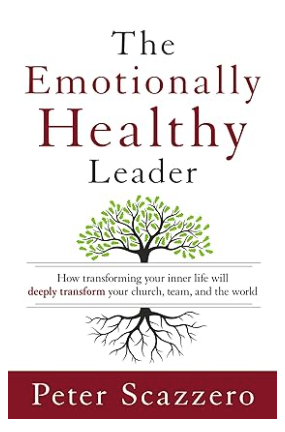
The Emotionally Healthy Leader is one of those rare books that does not just tell you how to lead better — it tells you how to become someone worth following. Peter Scazzero, founding pastor of New Life Fellowship Church in Queens, New York, writes from a place of raw honesty. He hit rock bottom in 1996 when his wife told him she was leaving the church he pastored — not because she was leaving him, but because she could no longer endure the emotionally unhealthy culture he had created. That crisis became the catalyst for a journey that would reshape everything he understood about Christian leadership.
Scazzero's core argument is simple and devastating: you cannot lead people to a place you have not been yourself. Emotional health and spiritual maturity are inseparable. You can have a growing ministry, a packed building, and an impressive resume — and still be an emotionally unhealthy leader who is slowly destroying yourself, your family, and the people you serve.
Part One: The Inner Life of a Leader
### Facing Your Shadow
Every leader has a shadow — the accumulation of untamed emotions, impure motives, unexamined wounds, and less-than-honest patterns that operate beneath the surface of your public ministry. Scazzero defines the shadow as the parts of yourself you refuse to see, the parts you hide from others, and the parts that hijack your leadership in moments of stress, conflict, or criticism.
The shadow is not theoretical. It shows up when you explode at a staff member over a minor mistake because it triggered a childhood wound you never addressed. It shows up when you avoid a hard conversation because your family of origin taught you that conflict means rejection. It shows up when you overwork to prove your worth because deep down you do not believe you are enough without your title and platform.
Scazzero argues that the first task of leadership is not vision casting or strategic planning — it is facing your shadow honestly before God. He walks leaders through their family of origin, their emotional triggers, and the ways their gifts can become weapons when operating out of brokenness rather than health. A gifted communicator who has not faced their shadow may use the pulpit for validation rather than proclamation. A strong administrator who has not done the inner work may control people rather than serve them.
### Leading Out of Your Marriage or Singleness
This is one of the most countercultural chapters in the book. Scazzero insists that your marriage or singleness is not a side issue that exists alongside your ministry — it is the most important leadership development tool you have. How you treat your spouse (or steward your singleness) is the truest indicator of your spiritual maturity, not your preaching, not your vision, not your results.
He challenges the pattern so common in ministry where the leader's family becomes a casualty of the leader's calling. Scazzero says plainly: if your ministry is thriving but your marriage is dying, you are not succeeding. You are failing at the most fundamental level.
### Slowing Down for Loving Union
Scazzero confronts the addiction to busyness that defines most ministry leaders. The chapter is built around a piercing question: Is your doing for God outpacing your being with God? Many leaders can point to years of activity, growth, and accomplishment — but when they are honest, they know their interior life with Christ has been running on fumes for a long time.
He introduces leaders to contemplative practices drawn from the Christian monastic tradition: silence, solitude, fixed-hour prayer, lectio divina, and the daily examen. These are not add-ons to an already packed schedule. They are the foundation that makes everything else sustainable. Scazzero argues that without a deep, unhurried relationship with Jesus, every other leadership practice is built on sand.
### Practicing Sabbath Delight
The final inner-life chapter addresses Sabbath — not as a legalistic rule but as a gift that exposes how much of your identity is wrapped up in productivity. Scazzero challenges leaders to stop for an entire day. No email. No sermon prep. No meetings. No strategic thinking. Just rest, delight, worship, and relationship.
He observes that Sabbath-keeping is the discipline most leaders resist the most — and that resistance reveals something important. If you cannot stop working without feeling anxious, useless, or afraid, then your identity is rooted in your work rather than in God. Sabbath exposes the idol and invites you back to the truth: you are beloved before you are productive.
Part Two: The Outer Life — Leading Others
In the second half of the book, Scazzero applies emotional health to the practical realities of leadership. He frames each topic as a tension to be managed rather than a problem to be solved.
### Planning and Decision Making
Emotionally healthy planning holds two things together: strategic thinking and waiting on God. Scazzero warns against the temptation to plan in purely human terms — collecting data, setting goals, executing — without creating space to hear from the Holy Spirit. He also warns against the opposite extreme: spiritual passivity disguised as trust, where leaders refuse to plan because they are waiting for a sign.
### Culture and Team Building
Building a healthy team requires the leader to address the elephants in the room — the unspoken tensions, unresolved conflicts, and cultural dysfunctions that everyone knows about but nobody names. Scazzero says that emotionally unhealthy leaders avoid these conversations because they fear conflict. But avoidance does not make the problem disappear; it makes it metastasize.
He also addresses the tension between being a supervisor and being a friend, between hiring and firing people while also being a church family. These dual relationships require enormous emotional maturity and clarity.
### Power and Wise Boundaries
Leaders have power, and emotionally unhealthy leaders either abuse it or deny they have it. Scazzero calls leaders to steward their power honestly — to set clear boundaries, to delegate effectively, and to recognize the limits of their own energy, gifting, and calling. The gift of limits is not a failure to trust God. It is a recognition that you are human.
### Endings and New Beginnings
Every ministry has seasons, and emotionally healthy leaders know how to grieve endings, release what is dying, and make room for what God is doing next. Scazzero draws on his own experience of leaving the senior pastorate after 26 years — a painful, grieving process that was also deeply necessary for the next season of his life and ministry.
The Four Marks of an Emotionally Unhealthy Leader
Throughout the book, Scazzero returns to four diagnostic markers that reveal emotional unhealth in leaders:
1. Low self-awareness — You do not know what you feel, why you react the way you do, or how your behavior affects others. 2. Prioritizing ministry over marriage or singleness — Your family pays the price for your calling, and you justify it as sacrifice. 3. Doing more activity for God than your relationship with God can sustain — You are running on fumes spiritually while performing at a high level publicly. 4. Lacking a work-Sabbath rhythm — You cannot stop without feeling guilty, anxious, or irrelevant.
If two or more of these describe you, Scazzero says, you are an emotionally unhealthy leader regardless of your external results. And the people around you are paying for it.