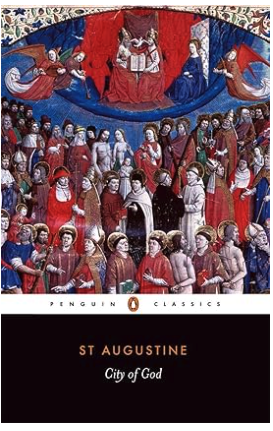
Summary
In the year 410 AD, the unthinkable happened. Rome, the Eternal City, the seat of civilization, the greatest power the world had ever seen, fell to Alaric and the Visigoths. Pagans blamed the Christians. They said Rome had abandoned its old gods, and the old gods had abandoned Rome. The empire was dying, they argued, because it had embraced a foreign religion that worshiped a crucified Jew.
Augustine of Hippo, the most brilliant mind in the early church, took up his pen and wrote the most ambitious theological work in Christian history. The City of God is not merely a defense of Christianity against pagan accusation. It is a complete reinterpretation of human history, politics, philosophy, and destiny through the lens of two invisible cities that have existed since the beginning of time and will endure until the end.
Two Cities, Two Loves
At the heart of Augustine's vision is a deceptively simple idea. From the beginning of human history, two cities have existed side by side, intertwined but fundamentally opposed. The City of God is defined by love of God carried to the point of contempt for self. The City of Man is defined by love of self carried to the point of contempt for God. Every human being, every nation, every empire belongs ultimately to one city or the other.
These are not geographical cities. You cannot find them on a map. They are spiritual realities, communities of allegiance, defined not by where you live but by what you love. The citizens of the City of God are pilgrims in this world, using earthly goods but never resting in them. The citizens of the City of Man pursue earthly glory, power, and pleasure as ultimate ends, and in doing so they build kingdoms that are destined to crumble.
Augustine's genius is that this framework explains everything. It explains why empires rise and fall. It explains why good people suffer and wicked people prosper. It explains why the church and the state will always exist in tension. And it explains why no political arrangement, no matter how just, will ever fully satisfy the human heart. The restlessness that drives every political revolution, every social movement, every personal ambition is the restlessness of a soul that was made for a city this world cannot provide.
The Critique of Pagan Rome
The first ten books of The City of God are a systematic demolition of pagan Rome's claim to greatness. Augustine shows that Rome's gods never protected it. Rome had suffered catastrophes, plagues, civil wars, and moral collapse long before Christianity arrived. The gods of Rome were not divine protectors but demons who enslaved their worshipers through superstition and vice.
Augustine draws on Roman historians themselves to make his case. He quotes Sallust, Varro, and Cicero to show that Rome's own thinkers recognized the republic's moral decay. The golden age pagans longed for never existed. Roman virtue was always mixed with ambition, cruelty, and the lust for domination. Rome did not fall because it became Christian. Rome was always falling, because it was built on self-love rather than love of God.
Augustine also dismantles pagan philosophy of religion. He demonstrates that Roman worship was never really about devotion to truth. It was about appeasing powers, securing prosperity, and maintaining political order. The Roman gods demanded rituals but offered no moral transformation. They required sacrifice but gave no hope beyond the grave. Christianity, by contrast, offered what paganism never could: a God who transforms the worshiper from the inside out, and a destiny that stretches beyond the grave into eternity.
This section is not merely historical polemic. Augustine is making a theological point that reverberates through every century since: no earthly empire deserves ultimate allegiance. Every political order is temporary. Every civilization is a mixture of good and evil. The Christian's true citizenship is elsewhere.
The Theology of History
In books eleven through twenty-two, Augustine constructs something entirely new: a theology of history. Before Augustine, most ancient thinkers saw history as either cyclical, endlessly repeating, or meaningless, random chaos. Augustine proposed something revolutionary: history is linear, purposeful, and moving toward a definite end ordained by God.
History begins with creation, not an accident, not an emanation, but a deliberate act of a personal God who made the world out of nothing and called it good. The fall of the angels introduced evil into the created order, not as a substance but as a privation, a turning away from the highest good. The fall of humanity followed, and with it the birth of the two cities.
Augustine traces both cities through Scripture and secular history. The City of God runs through Abel, Abraham, Moses, David, the prophets, and finally to Christ and His church. The City of Man runs through Cain, Babel, Egypt, Babylon, and Rome. The two are intertwined in this age. You cannot always tell them apart from the outside. But they are heading toward radically different destinations.
This linear view of history, moving from creation through fall through redemption toward final consummation, became the foundation of the Western understanding of progress, purpose, and meaning. Before Augustine, the dominant pagan view was that history goes nowhere. After Augustine, the West believed that history is a story, and that story has an Author who is moving it toward a conclusion.
Providence and the Problem of Evil
One of Augustine's most enduring contributions is his treatment of evil and divine providence. If God is good and all-powerful, why does evil exist? Augustine's answer is carefully layered.
First, evil is not a thing. It is the absence of good, the way darkness is the absence of light. God did not create evil. Evil entered the world through the free choices of rational beings, angels and humans, who turned away from God toward lesser goods.
Second, God permits evil but is never its author. He sovereignly governs all things, including the actions of wicked beings, and He brings good out of evil in ways that finite minds cannot always trace. The cross of Christ is the supreme example: the greatest evil in history became the means of the world's salvation.
Third, the suffering of this life is temporary. Augustine insists on the reality of eternal judgment and eternal joy. The apparent injustice of the present world is not the final word. God will set all things right, not on our timeline, but on His.
The Church as Pilgrim Community
Augustine's vision of the church is neither triumphalist nor defeatist. The church in this age is a mixed body, wheat and tares together. Not everyone who sits in the pew belongs to the City of God, and not everyone outside the church walls belongs to the City of Man. Only God knows the heart.
This means the church should not expect to build heaven on earth through political power. The City of God will not arrive through legislation, conquest, or social engineering. It will arrive when Christ returns. In the meantime, Christians are pilgrims, resident aliens who participate in earthly society, seek justice, love their neighbors, and serve the common good, but who never mistake any earthly institution for their true home.
At the same time, Augustine insists that the church has a public role. Christians should work for justice, care for the poor, restrain evil through law, and participate in governance when called to do so. But they must do so with open eyes, knowing that even the best human institutions are provisional and imperfect. The temptation of every generation is to confuse the City of Man with the City of God, to invest ultimate hope in a political movement, a nation, or a party. Augustine's framework inoculates against that temptation without producing withdrawal or apathy.
The Eternal City
Augustine closes with a breathtaking vision of the final state. The City of God is not an abstraction. It is a real destination, the new heavens and the new earth, where God's people will live in resurrected bodies, in perfect community, in unending worship, in a peace that no empire could ever provide.
Augustine describes the resurrected life with both reverence and specificity. The body will be perfected, not discarded. The scars of earthly suffering will be transformed into marks of glory. The saints will know one another, love one another, and worship together in a communion that fulfills every longing the earthly church could only approximate.
This is not escapism. For Augustine, the reality of the eternal city is precisely what frees Christians to engage the present world without despair. You can work for justice without being crushed when justice fails, because you know the final court is still in session. You can love your neighbor without being destroyed by their rejection, because your ultimate acceptance comes from elsewhere. You can lose everything, as Augustine's world was losing everything, and still have hope, because the city that cannot be shaken is still standing.
The City of God has shaped every subsequent century of Western civilization. It influenced medieval political theory, Reformation theology, and modern debates about church and state. It remains the definitive Christian answer to the question every generation must face: what do we do when the world falls apart?