Summary
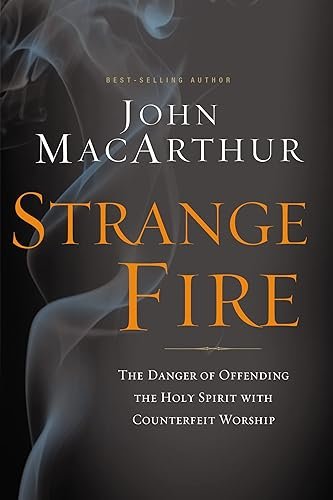
John MacArthur has never been accused of being unclear, and Strange Fire may be his most provocative book. Published alongside the Strange Fire Conference he hosted at Grace Community Church in 2013, this book is a full-scale critique of the modern charismatic movement -- not just its excesses or its fringe elements, but what MacArthur considers its foundational theology. The title is drawn from Leviticus 10, where Aaron's sons Nadab and Abihu offered "strange fire" -- unauthorized worship -- before the Lord, and were consumed. MacArthur's thesis is that the charismatic movement, in all its varieties, is offering a similar kind of unauthorized fire: worshiping the Holy Spirit in ways that the Spirit Himself has not sanctioned, and in doing so, dishonoring the very Person they claim to honor.
The Cessationist Foundation
MacArthur's argument rests on several pillars. The first is cessationism: the theological conviction that the miraculous sign gifts -- tongues, prophecy, healing, and miracles -- ceased with the death of the apostles and the completion of the New Testament canon. He argues this from 1 Corinthians 13:8-10, Ephesians 2:20 (which describes apostles and prophets as the "foundation" of the church -- and a foundation is laid once), and from the broader trajectory of redemptive history. The sign gifts, MacArthur contends, served a specific purpose: to authenticate the apostles and confirm the new revelation they were delivering. Once that revelation was complete and codified in the New Testament, the authenticating signs were no longer necessary.
MacArthur reinforces this biblical argument with church history. He surveys the post-apostolic era and argues that the miraculous gifts largely disappeared from mainstream church life after the first century. While continuationists point to reports of miracles in the church fathers, MacArthur contends that these reports are sporadic, often unreliable, and that the most theologically careful fathers -- including John Chrysostom and Augustine (in his earlier writings) -- acknowledged that the gifts had ceased or diminished. He traces the modern charismatic movement to the early 1900s and the Azusa Street Revival, characterizing it as a departure from historic Christian orthodoxy rather than a restoration of it.
Critique of Charismatic Theology and Practice
The second pillar of MacArthur's argument is his critique of charismatic theology and practice. He surveys what he considers the movement's most damaging features: the prosperity gospel, faith healing charlatans, the "holy laughter" movement, the emphasis on personal experience over doctrinal truth, and the elevation of prophetic words to a status that rivals Scripture. He is particularly pointed in his criticism of television preachers and megachurch leaders who claim healing powers, prophetic abilities, or direct communication from God while displaying what MacArthur sees as theological ignorance, moral compromise, or financial exploitation.
MacArthur is careful to note that he is not questioning the sincerity of all charismatics. He acknowledges that millions of charismatic believers genuinely love Jesus and hold to orthodox Christology. But he argues that sincerity is not enough -- Nadab and Abihu may have been sincere too. What matters is whether worship is authorized by God, and MacArthur believes that the charismatic approach to the Holy Spirit is fundamentally unauthorized. He draws a hard line: the modern gifts movement, regardless of the sincerity of its participants, is built on a false understanding of how the Spirit works.
The Spirit's True Ministry
One of the book's most significant sections addresses the doctrine of the Holy Spirit directly. MacArthur argues that the charismatic movement has distorted the Spirit's character and ministry. The Spirit's primary work, he contends, is to glorify Christ, illuminate Scripture, convict of sin, and produce the fruit described in Galatians 5. When the emphasis shifts from these works to miraculous signs, ecstatic experiences, and dramatic manifestations, the Spirit is effectively recast in a way that does not match the biblical portrait. MacArthur sees the charismatic emphasis on power, experience, and supernatural phenomena as a subtle but serious idolatry -- making the Spirit's gifts rather than the Spirit's character the center of devotion.
MacArthur also addresses the global growth of the charismatic movement, which continuationists often cite as evidence of the Spirit's ongoing work. He argues that numerical growth is not evidence of theological truth -- many false religions and heretical movements have grown rapidly. He is particularly concerned about the spread of the prosperity gospel in the Global South, which he sees as a predatory theology that exploits the poor. While acknowledging that many non-Western charismatics are genuine believers, he worries that the theological foundation of their faith is compromised by errors that will eventually bear destructive fruit.
The Specific Gifts
The book includes chapters on specific gifts. MacArthur's treatment of tongues argues that the biblical gift was always the supernatural ability to speak in recognizable human languages (as at Pentecost in Acts 2), not the ecstatic, unintelligible speech practiced in most charismatic churches today. He contends that modern tongues bear no resemblance to the biblical gift and are better explained by psychological and sociological factors than by the Holy Spirit's activity. His treatment of prophecy argues that all genuine prophecy is infallible -- there is no such thing as a partially accurate prophetic word from God. If modern prophets get things wrong (and they do, frequently), it proves they are not genuine prophets. His treatment of healing acknowledges that God can and does heal, but argues that the gift of healing -- the ability to heal at will, as the apostles did -- is no longer operative.
The Broad Brush Critique
MacArthur's tone throughout is direct, sometimes sharply so. He names names. He calls out specific leaders and movements. He does not hedge or qualify his conclusions with diplomatic ambiguity. This directness has made the book deeply polarizing. Supporters praise it as a courageous defense of biblical fidelity against a movement they see as theologically dangerous. Critics -- including many thoughtful continuationists who share MacArthur's concerns about charismatic excess -- argue that the book paints with too broad a brush, failing to distinguish between the prosperity gospel charlatans and the serious, biblically grounded continuationists like Wayne Grudem, Sam Storms, and D.A. Carson.
This is a legitimate critique. MacArthur's approach groups together Benny Hinn and Sam Storms, Kenneth Copeland and Wayne Grudem, as though they all share the same theological DNA. Many readers find this unfair. There is a vast theological distance between a prosperity preacher on television and a Cambridge-trained scholar who has devoted his career to careful exegesis of the gifts passages. MacArthur would respond that the underlying premise -- that miraculous gifts continue -- is the root error, and that all who hold it are participating in the same fundamental mistake, however differently they express it.
Whether you agree with MacArthur or not, Strange Fire represents the cessationist position at its most confident and comprehensive. It forces charismatic and continuationist believers to reckon with serious questions: Are modern tongues the same as biblical tongues? Has the prophetic movement produced more false words than true ones? Has the pursuit of experience come at the expense of doctrinal fidelity? Can a movement with so many visible abuses claim to be driven by the Holy Spirit?
These are uncomfortable questions, and MacArthur asks them without flinching. The book deserves a serious reading -- not because every argument is equally strong, but because the concerns it raises are real, and any movement that cannot answer its critics honestly has not yet earned the confidence it claims.