Summary
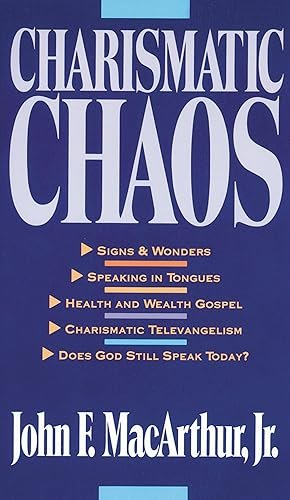
Before Strange Fire made headlines in 2013, John MacArthur had already laid the groundwork for his critique of the charismatic movement with Charismatic Chaos, published in 1992. If Strange Fire is MacArthur's broadside against the movement at the height of its global influence, Charismatic Chaos is his earlier, more systematic examination of what he sees as its theological roots and rotten fruit. The book is less polemical in tone than its successor -- though still unmistakably direct -- and more focused on building a careful case from Scripture and church history.
Experience Over Scripture: The Root Error
MacArthur's central concern is that the charismatic movement elevates experience over Scripture. This, in his view, is not a secondary issue or a matter of emphasis -- it is a fundamental epistemological error that distorts everything downstream. When personal experience becomes the primary lens through which believers interpret reality, the Bible ceases to function as the supreme authority. It becomes one input among many, and the most vivid, emotionally compelling input (a vision, a tongues experience, a prophetic word, a healing service) tends to win. MacArthur sees this as a recipe for theological chaos -- hence the title.
The book opens with a survey of the charismatic movement's history and scope. MacArthur traces its modern origins to the Azusa Street Revival in 1906, led by William Seymour, and follows its development through the classical Pentecostal denominations, the mid-century charismatic renewal in mainline churches, and the third wave or "signs and wonders" movement associated with John Wimber and the Vineyard churches. He acknowledges the movement's extraordinary growth -- by the early 1990s, charismatic and Pentecostal believers numbered in the hundreds of millions worldwide -- but argues that growth is not evidence of truth.
The Doctrine of Revelation
MacArthur then builds his theological case. He begins with the doctrine of revelation. He argues that the Bible is God's complete, sufficient, and final written revelation to humanity. Nothing needs to be added to it. The canon is closed. Any claim to ongoing prophecy, new revelation, or authoritative words from God outside of Scripture undermines this foundational doctrine. Even if the claimed revelation does not technically contradict the Bible, the very act of treating something alongside Scripture as a word from God functionally adds to the canon. MacArthur draws a direct line from this claim to the cults: Mormonism, Jehovah's Witnesses, and other groups all began by claiming additional revelation beyond Scripture. The charismatic movement, he argues, walks dangerously close to the same path.
This is a strong claim, and MacArthur is aware that many charismatics would protest it. Continuationists like Grudem and Storms explicitly affirm the sufficiency of Scripture and insist that modern prophetic words are subordinate to it. MacArthur is not persuaded. He argues that once you grant that God gives specific, personal revelations through prophecy, dreams, and impressions, you have functionally created a secondary authority that competes with Scripture, regardless of how carefully you qualify it. The average believer in the pew will not maintain the sophisticated theological distinctions that scholars draw between canonical revelation and congregational prophecy. In practice, "God told me..." carries enormous weight, and it is very difficult to challenge someone who claims divine authority for their words.
The Specific Gifts
MacArthur devotes several chapters to the specific gifts. His treatment of tongues argues, as in Strange Fire, that the biblical gift was the miraculous ability to speak in real human languages for the purpose of evangelism and as a sign to unbelievers (especially Jewish unbelievers, following Isaiah 28:11-12). He surveys the linguistic research on modern glossolalia and concludes that it does not exhibit the characteristics of any known human language. He also argues that tongues was the least important of the gifts, listed last in Paul's enumerations, and that the Corinthian church's overemphasis on it was a mark of their immaturity -- not something to be emulated.
His treatment of prophecy follows the cessationist logic: all true prophecy is infallible, modern "prophets" are routinely inaccurate, therefore modern prophecy is not the biblical gift. He documents numerous failed prophecies from prominent charismatic leaders and argues that the movement has a serious accountability problem. When a prediction fails, charismatic leaders typically offer explanations rather than repentance -- the conditions changed, the timing was off, the people lacked faith, the word was "for a season." MacArthur finds this evasive and dangerous.
Healing and the Prosperity Gospel
MacArthur's treatment of healing is nuanced in a way that sometimes surprises readers. He clearly affirms that God heals. He believes in praying for the sick. He acknowledges that the New Testament instructs elders to anoint the sick with oil and pray over them (James 5:14). What he denies is that any person today has the apostolic gift of healing -- the ability to heal at will, on demand, as a demonstration of divine authority. He draws a distinction between God healing in response to prayer (which he affirms) and a human being possessing a "gift of healing" that they can exercise whenever they choose (which he denies).
A particularly significant section of the book addresses the prosperity gospel, which MacArthur sees as the charismatic movement's most destructive theological export. He documents the theological errors of the Word of Faith movement -- the idea that God promises health and wealth to every believer who has sufficient faith, that speaking in faith creates reality, and that poverty and illness are always signs of insufficient faith or unconfessed sin. MacArthur marshals extensive biblical evidence against these claims and argues that they are not merely wrong but cruel, particularly when applied to believers in poverty, chronic illness, or suffering.
Spiritual Warfare and Positive Vision
MacArthur also addresses the question of spiritual warfare as practiced in charismatic circles. He is skeptical of the idea that Christians need to "bind" territorial spirits, engage in strategic-level spiritual warfare, or do battle with specific demons over geographic regions. He argues that the New Testament's approach to spiritual warfare is primarily about truth, obedience, and resistance (Ephesians 6; James 4:7), not about dramatic encounters with demonic entities.
The book's final chapters offer MacArthur's positive vision: a church centered on the exposition of Scripture, governed by qualified elders, marked by doctrinal precision, and empowered by the Spirit's work of illumination, sanctification, and fruit-bearing. He does not believe this vision is spiritually dry or powerless. On the contrary, he argues that the Holy Spirit's greatest work is the transformation of the human heart through the Word of God, and that this work is more miraculous than any tongue, prophecy, or healing.
Charismatic Chaos is essential reading for understanding the conservative evangelical critique of the charismatic movement. It is thorough, biblically engaged, and uncompromising. Its weaknesses are the same as those in Strange Fire: a tendency to conflate serious, scholarly continuationism with televangelist excess, and a reluctance to engage with the strongest versions of the opposing argument. But its strengths -- particularly its defense of Scripture's sufficiency and its documentation of charismatic accountability failures -- make it a book that continuationists ignore at their peril.