Summary
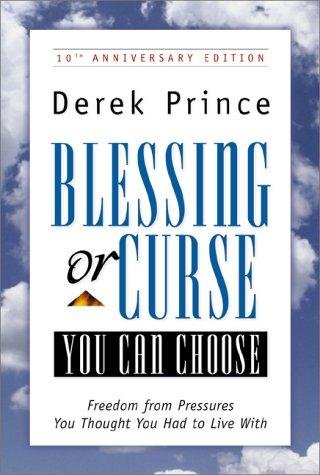
Of all the books Derek Prince wrote, Blessing or Curse: You Can Choose may be the most personally transformative for the greatest number of readers. While his other works focus on deliverance and spiritual warfare in more direct combat terms, this book addresses something that many Christians experience but few can name: the persistent, inexplicable patterns of failure, sickness, relational breakdown, and frustration that seem to follow certain people and certain families regardless of how hard they try or how sincerely they pray.
Prince's thesis is that blessings and curses are real spiritual forces -- not superstitions, not relics of the Old Testament, and not metaphors. They are operative realities that shape the trajectory of lives, families, and even nations. And the good news at the heart of the book is that through the finished work of Christ on the cross, every curse can be identified, confronted, and broken. The choice is real, and it belongs to the believer.
The Biblical Basis
Prince builds his case from Scripture with characteristic thoroughness. He begins in Deuteronomy 28, which is perhaps the most comprehensive biblical passage on blessings and curses. In that chapter, God lays out the terms of the covenant with Israel: obedience leads to blessing, and disobedience leads to cursing. The blessings are expansive -- prosperity, health, victory, fruitfulness, favor. The curses are equally comprehensive -- poverty, sickness, defeat, barrenness, confusion, and oppression.
Prince argues that while Christians are not under the Mosaic law in the same way Israel was, the principles of blessing and cursing are woven throughout the entire Bible, from Genesis to Revelation. God blessed Abraham, and that blessing flowed through generations. God cursed the ground after Adam's sin, and that curse had consequences that lasted millennia. Blessings and curses are not isolated events. They are streams that flow forward through time, affecting everything in their path.
He also draws on Proverbs 26:2, which says that a curse without cause does not come to rest. In other words, curses are not random. There is always a reason -- a root, a cause, a door -- through which a curse enters. This is an encouraging principle because it means that if the cause can be identified, the curse can be addressed.
Recognizing the Signs of a Curse
One of the most impactful sections of the book is Prince's list of indicators that a curse may be operating in a person's life. He identifies several patterns.
Chronic financial insufficiency. Not just temporary hardship, but a pattern where money seems to evaporate, opportunities collapse, and financial stability remains perpetually out of reach despite hard work and good intentions.
Recurring health problems. Especially conditions that are hereditary, chronic, or that resist treatment. Prince notes that certain family lines seem marked by specific diseases -- cancer, heart disease, diabetes, mental illness -- generation after generation.
Breakdown of relationships and marriages. When a family has a pattern of divorce, estrangement, abuse, or abandonment that repeats across generations, Prince suggests a curse may be at work.
A history of premature or unnatural deaths. Accidents, suicides, and early deaths that cluster in family lines are, in Prince's view, a significant indicator.
Chronic emotional struggles. Depression, anxiety, irrational fears, and feelings of rejection that persist despite counseling and prayer may have a spiritual root.
Patterns of failure and frustration. Repeated near-misses, projects that always fall apart at the last moment, and the sense that something invisible is blocking progress.
Prince is careful to note that not every difficulty in life is a curse. But when these patterns are persistent, generational, and resistant to normal remedies, it is worth investigating the spiritual dimension.
Sources of Curses
Prince identifies several major sources through which curses enter.
Generational curses. God warned that the iniquity of the fathers would be visited upon the children to the third and fourth generation. Prince takes this seriously. He has ministered to countless people whose problems traced directly back to the sins, occult involvement, or covenant-breaking of their ancestors. These are not punishments for someone else's sin but spiritual consequences that flow through family lines like polluted water through a river system.
Self-imposed curses. Prince highlights the power of the tongue, drawing on Proverbs and James. When people habitually speak death over themselves -- "I'll never amount to anything," "Nothing good ever happens to me," "I'm just like my father" -- they are, in spiritual terms, pronouncing curses over their own lives. Words carry creative and destructive power, and Prince urges believers to take seriously what they speak.
Curses from authority figures. Parents, pastors, teachers, and other authority figures carry special weight in the spiritual realm. When a father tells a child, "You're worthless," or a pastor pronounces judgment over a congregant, those words can function as curses that bind and limit the person for years or decades.
Occult involvement. Any participation in occult practices -- fortune telling, astrology, witchcraft, spiritism, secret societies, and certain Eastern religious practices -- opens the door to curses. Prince is emphatic that even casual or curiosity-driven involvement can have serious spiritual consequences.
Breaking covenant with God. Disobedience to clear biblical commands, particularly in areas like tithing (Malachi 3), sexual immorality, and idolatry, can bring a person or family under a curse.
Servants of Satan. Prince acknowledges that deliberate curses can be spoken by practitioners of witchcraft, sorcery, or other occult arts against believers. While these curses have no power over a believer who is walking in righteousness and covered by the blood of Jesus, they can find landing places when there are open doors in a person's life.
The Exchange at the Cross
The theological heart of the book is Prince's teaching on what he calls "the divine exchange" at the cross. Drawing on Isaiah 53, Galatians 3:13-14, and related passages, Prince argues that at the cross, Jesus took upon Himself every curse that was due to humanity, so that believers could receive every blessing that was due to Him.
This is not abstract theology for Prince. It is the operational basis for freedom. Jesus was made a curse so that we might receive the blessing of Abraham. He bore sickness so that we might have health. He endured poverty so that we might have provision. He suffered rejection so that we might have acceptance. Every negative consequence of sin and disobedience was placed on Jesus, and every positive provision of God's covenant was made available to those who believe.
Prince teaches that this exchange is complete in principle but must be appropriated by faith. It does not happen automatically. Believers must understand what Christ accomplished, identify the curses operating in their lives, and actively claim the exchange through prayer, confession, and faith.
How to Break Curses
Prince provides a practical, step-by-step process for breaking curses. The process is straightforward and accessible.
Step 1: Establish your relationship with Christ. Salvation is the foundation. Only those who are in Christ have the legal standing to claim the benefits of His sacrifice.
Step 2: Confess and repent of any known sin. Personal sin gives the enemy legal ground. Honest confession and repentance remove that ground.
Step 3: Forgive everyone who has wronged you. As in his other books, Prince identifies unforgiveness as a critical barrier. Holding onto bitterness keeps the door open for the curse to continue operating.
Step 4: Renounce all involvement with the occult. This includes personal involvement and, where known, ancestral involvement. Prince recommends being specific: name the practices, renounce them verbally, and sever the connection.
Step 5: Break the curse verbally in the name of Jesus. Prince teaches believers to make a specific, spoken declaration: "In the name of Jesus Christ, I break every curse that has been operating in my life and in my family line. I claim the blessing that Christ purchased for me at the cross."
Step 6: Claim the blessing. Freedom from a curse is only half the picture. Believers should actively declare and receive the corresponding blessing. Where there was poverty, claim provision. Where there was sickness, claim health. Where there was rejection, claim acceptance.
Step 7: Walk in the blessing. Maintaining freedom requires ongoing obedience, faith, and vigilance. Prince counsels believers to guard their words, walk in forgiveness, stay connected to community, and remain rooted in Scripture.
Walking in Blessing
The final section of the book shifts from breaking curses to actively walking in blessing. Prince paints a picture of what the blessed life looks like -- not a life free from all difficulty, but a life marked by the evident favor and provision of God. He encourages believers to make Deuteronomy 28:1-14 a personal confession, declaring God's blessings over their lives, families, finances, health, and ministries.
Prince also addresses the corporate dimension. Churches, ministries, and even nations can be under blessings or curses. Leaders have a special responsibility to identify and break curses that may be operating over their organizations and to create environments where blessing can flow freely.